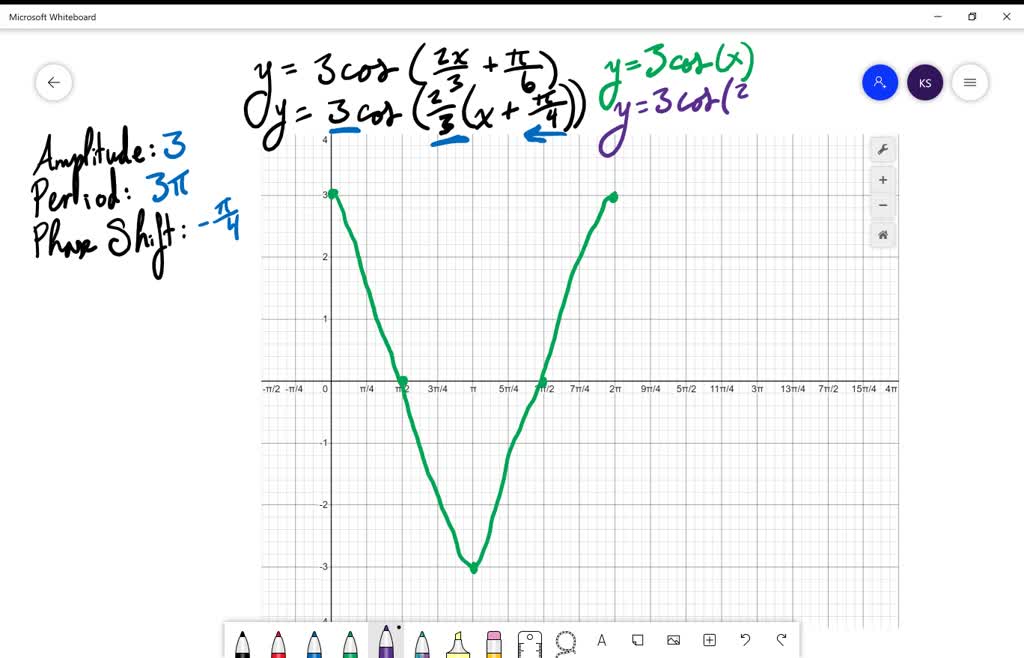
Period Phase Shift Amplitude Calculator. If you need to graph a trigonometric function, you should use this trigonometric graph maker. In this video i show you how to calculate the amplitude, period, phase shift, and vertical shift of a sine or cosine wave.
SOLVEDDetermine the amplitude, period, and phase… from www.numerade.com
The equation for a sine curve with amplitude 2 and period 4 pi radians is f (x) = 2 sin (x/2). Specifying a sine (or cosine) curve with a given amplitude, period, and phase shift defines a unique set of points in the plane. B = π b = π.
Therefore, The Magnitude Of Oscillation Amplitude Is Always Positive.
Amplitude = 3, period = 2π, and a > 0 12. Cosine with amplitude a and period 2pi/b and phase shift p 1. The amplitude period phase shift calculator is made use of for trigonometric functions which aids us in calculations of vertical shift, period, phase, and amplitude shift of sine and cosine functions effortlessly.
A = 2, B = 1/2, C = 0, D = 0.
Where, amplitude = a, time period = 2π/b, phase shift = c, vertical shift = d. A = 1 a = 1. Therefore, period of this function is equal to 2.
Given A Periodic Function F:
Another way to find this same value is to set inside of parenthesis equal to 0, then solve for x. Let’s solve this step by step. Y = tan ( + ± 2 62/87,21 given a = 1, b = 1, h = ± and k = ±2.
By Using This Website, You Agree To Our Cookie Policy.
D = 0 d = 0. The equation for a sine curve with amplitude 2 and period 4 pi radians is f (x) = 2 sin (x/2). The amplitude period phase shift calculator is used for trigonometric functions which helps us in the calculations of vertical shift, amplitude, period,.
Using Phase Shift Formula, Y = A Sin (B (X + C)) + D On Comparing The Given Equation With Phase Shift Formula We Get Amplitude, A = 3 Period, 2Π/B = 2Π/4 = Π/2 Vertical Shift, D = 2 So, The Phase Shift Will Be −0.5 Which Is A 0.5 Shift To The Right.
To find amplitude, look at coefficient in front of sine function. State the amplitude, period, phase shift, and vertical shift for each function. Y = sin (t) this is what it looks like on a graph.