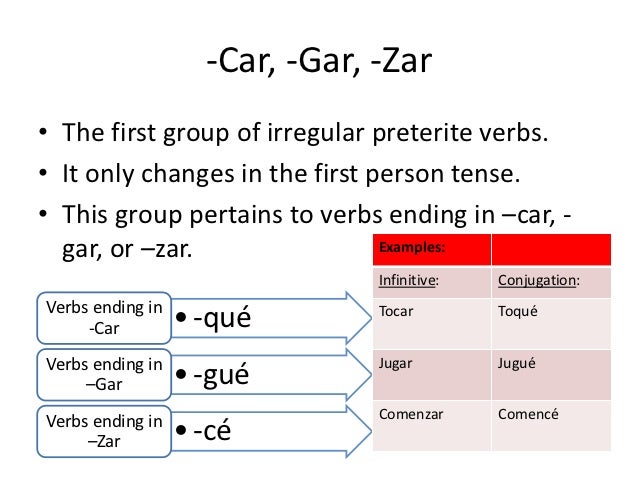
Tocar Conjugation Preterite. See the tables below for the full conjugations in both positive and negative forms. Tocar is conjugated as an irregular verb in the preterite tense.
Grammar book WIP from www.slideshare.net
Tocar in the indicative preterite. Tocar appears on the 100 most used spanish verbs poster as the 4th most used regular ar verb.for the preterite tense conjugation, go to tocar preterite tense conjugation.tocar conjugation: The indicative preterite tense of tocar is used to talk about things in the short term past, and in the indicative.
Tocar Appears On The 100 Most Used Spanish Preterite Tense Verbs Poster As The 36Th Most Used Irregular Verb.
Tocar is conjugated as an irregular verb in the preterite tense. In the preterite “yo” form, there is a one small spelling change, c → qu ,. Tocar appears on the 100 most used spanish verbs poster as the 4th most used regular ar verb.for the preterite tense conjugation, go to tocar preterite tense conjugation.tocar conjugation:
Using The Chart Below You Can Learn How To Conjugate The Spanish Verb Tocar In Present Perfect Tense.
A clean and easy to read chart to help you learn how to conjugate the spanish verb tocar in preterite tense. Tocar in the indicative preterite. Yo toco, tú tocas, él / ud.…
The Indicative Preterite Tense Of Tocar Is Used To Talk About Things In The Short Term Past, And In The Indicative.
Yo hube tocado, tú hubiste tocado, él / ud.… browse verbs It also means 'to play' (music or a musical instrument). Tocar is a spanish verb meaning to touch.
Present Tense Yo Toco Tú Tocas Él/Ella Toca Nosotros/As Tocamos Vosotros/As To
Yo toqué, tú tocaste, él / ud.… Vos is an informal second person singular (you) form used in parts of latin america. Tocar is a spanish verb meaning to touch.
Tocar Is A Spanish Regular Ar Verb Meaning To Touch.
Using the chart below you can learn how to conjugate the spanish verb tocar in preterite tense. The indicative preterite of tocar is used to talk about actions completed in the past, at a specific point in time. Examples of use in present tense, past tenses, subjunctive moods, etc.